A NASTY ENVIRONMENT
High Performance Concrete in Texas Heat
Designing water projects in El Paso that do not have leakage problems is not too difficult to do. Designing water projects in El Paso that do not have leakage problems more than a decade after construction is a much, much larger challenge. El Paso gets hot, has low humidity, and has large temperature swings. Concrete does not like those conditions.
The Roberto R. Bustamante Waste Water Treatment Plant (WWTP) and the Jonathon W. Rogers Water Treatment Plant (WTP) went into service in January 1991 and May 1993, respectively. Inspection of the projects in April 2004 showed both projects are still performing exceptionally well.
During the design stages, the two El Paso engineering firms of Robert Navarro & Associates and Parkhill, Smith, & Cooper considered various options before deciding on Type K Concrete (commonly called shrinkage compensating concrete). Type K was used to control cracking, which in turn would reduce leakage and protect the reinforcing steel. Each firm had used Type K on previous projects and was aware of its benefits. Each firm has continued to specify Type K on other water projects, including booster station roofs.
Evan Anderson of Bradbury Stamm Construction, Albuquerque, NM, who was the contractor on both projects states “With the Type K we did not have the leaking problems to deal with that we normally see on water projects using portland cement.” The concrete was supplied by Jobe Concrete Products, Inc. of El Paso.
The principle behind Type K concrete is simple. Portland cement shrinks and it is that shrinkage of the cement paste that causes the shrinkage in the concrete. On the other hand, Type K cement expands. For the first seven days after placement, the concrete will expand slightly. Most of the potential expansion is restrained by the reinforcement. This restraint puts the reinforcement into tension and the concrete into compression, which is where these two materials work best. After seven days, when the concrete shrinks, it merely shrinks the small amount that it had expanded and relieves the stresses in the reinforcement and concrete. The concrete ends up the same size as when it was placed and in a neutral stress condition. As stated in section 1.2 of ACI 223-98 Standard Practice for the Use of Shrinkage-Compensating Concrete: “... expansion will induce tension in the reinforcement and compression in the concrete. On subsequent drying, the shrinkage merely relieves the expansive strains...” Section 3.4.5 says that “...contraction joints are eliminated....”
Type K concrete tries to lift up in the middle rather than at the edges, but the weight· of the slab prevents that so the slabs stay flat. As stated in section 3.4.2 of ACI 223-98 “...restrained expansive strains are greater at the top surface than at the bottom, so reversed curling conditions develop... counterbalanced by the dead weight of the slab itself.”
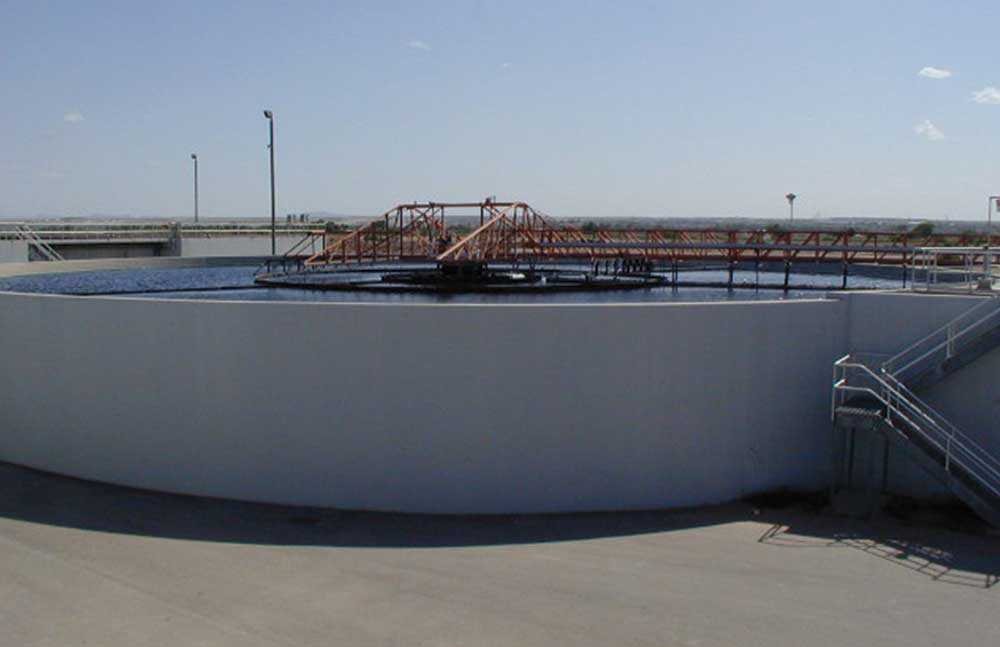
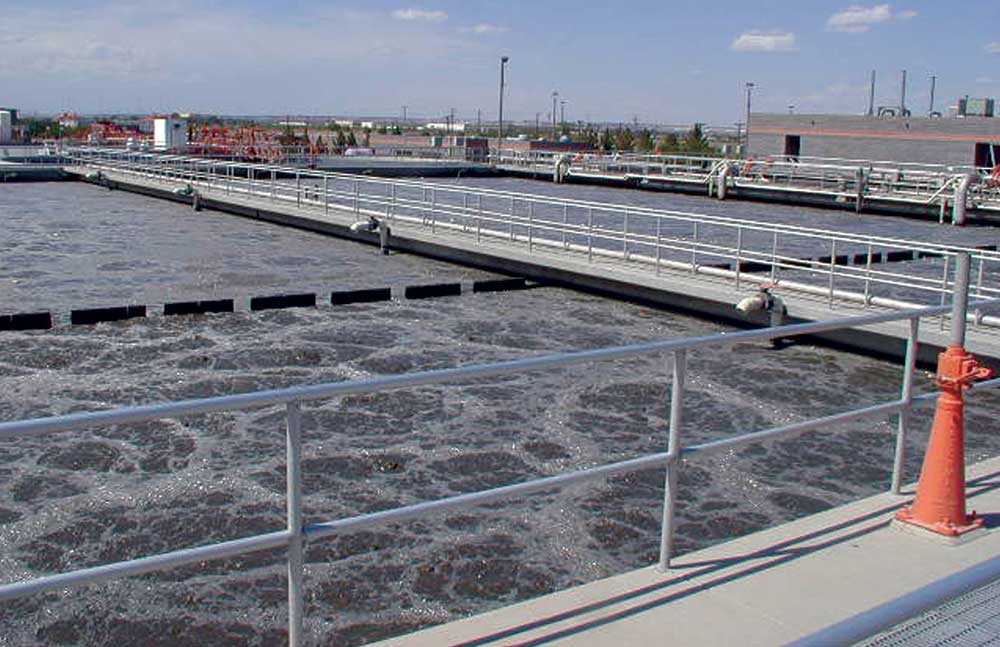
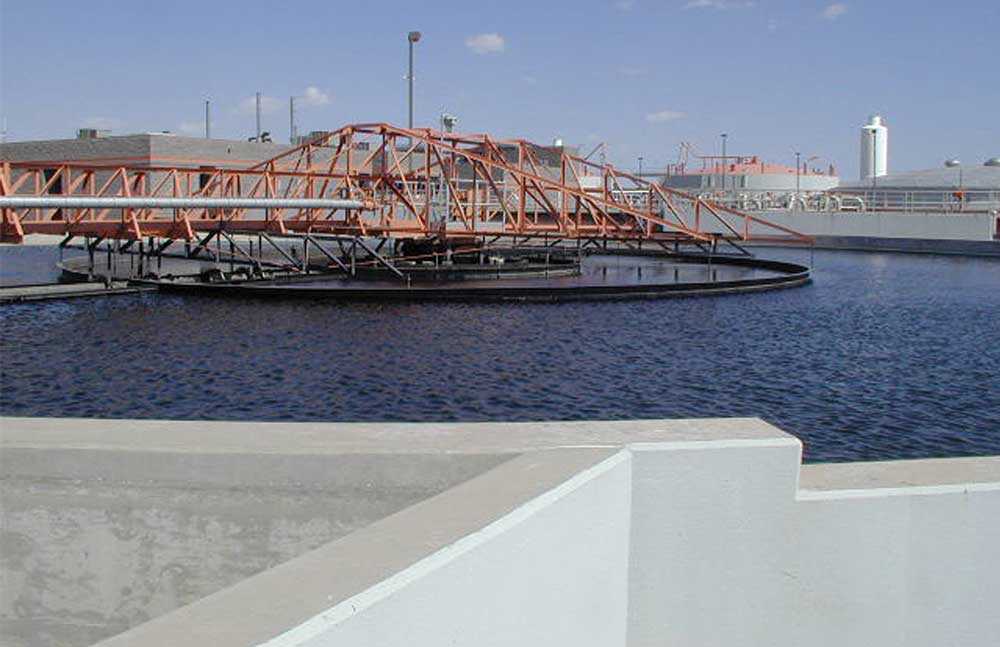
The Bustamante WWTP includes 110-ft diameter by 30-ft high digesters, 120-ft diameter by 20-ft high primary clarifiers, and 140-ft diameter by 16-ft high secondary clarifiers. They were all constructed with no joints using shrinkage-compensating concrete. More than ten years later they are still crack free and leak free. Figure 1 is a typical secondary clarifier. The straight walls were constructed with 100-ft joint spacing and while there are a few eight cracks, they are virtually maintenance free. Jose L. Ramirez, the Plane Superintendent, stated “There are a few little cracks, but very few compared to other plants.”
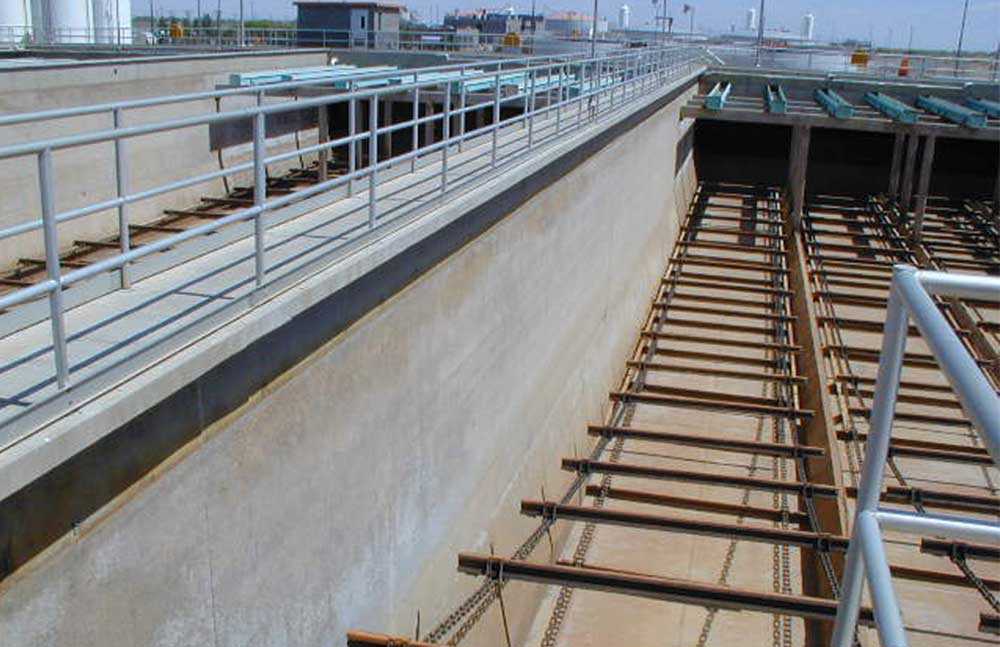
The Rogers WTP was constructed with 90-ft joint spacing in the walls as shown in Figure 2. This plant has one additional factor to withstand. Because the flow in the Rio Grande is not always adequate, there are extended periods when the plant is emptied and just sits there. This idle time was only a couple months a year originally. Art Ruiz, the plant superintendent says “The idle period generally exceeds six months a year now.” Extended dry periods are not good for concrete, particularly in El Paso’s hot, low humidity environment. In spite of that, the concrete has only a few small cracks, but no real problems.
Much of the additional cost of the Type K cement for both projects was offset by upfront savings. Fewer joints meant savings on water stops, labor, and construction time for the slabs and walls. And without sawcut joints in the slabs, dowels baskets were eliminated.
On some projects, the engineers choose to omit the temperature steel because it is not required in tank walls when Type K is used. On some projects, the thickness of the walls is determined by the cover required for the rebars and without the temperature steel, the walls can actually be made thinner. On some projects, all steel is left out of the slabs, since the steel was there for crack control only. But that was not the case on these two projects.
The preceding was supplied by CTS Cement Manufacturing Corporation. For further information, please contact CTS Cement Manufacturing Corporation at info@ctscement.com.
CTS Cement Manufacturing Corp. is the leading manufacturer of advanced calcium sulfoaluminate (CSA) cement technology in the United States. Our Komponent® and Rapid Set® product lines are renowned for proven performance, high quality, and exceptional service life. Contact CTS Cement for support on your next project.
Call 1-800-929-3030.
Original publication: Government Engineering (2006, January-February). A Nasty Environment: High Performance Concrete in Texas Heat.