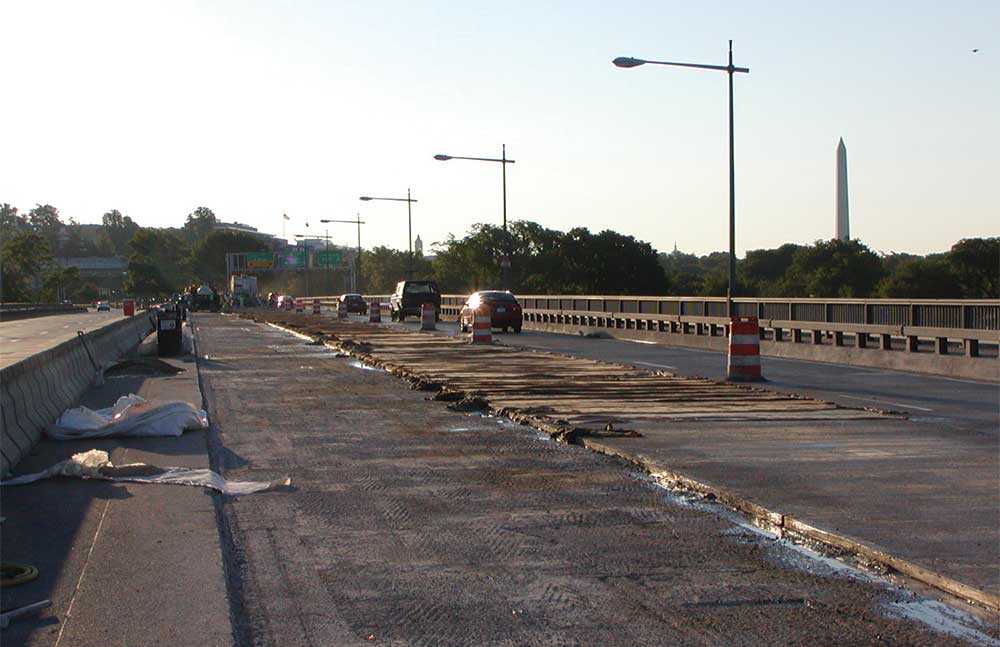
Concrete is the most commonly used manufactured construction material in the world. In the United States alone there are about 9 billion cubic yards of in-place concrete, the majority of which is more than 20 years old. Throughout the country, it has been used on about 350,000 concrete bridges or steel bridges with concrete decks, many of them in climates with cold winter weather.
While the useful life of concrete placed outdoors can exceed 50 years, installations frequently do not achieve that. Most notably, exposure to freeze/thaw cycles, deicing salts, and other aggressive chemicals can shorten the life cycle considerably.
The annual cost for repair, rehabilitation, strengthening, and protection is about $18 billion. Of this, about $8 billion is used for bridge repair, with a large portion of that used to repair the decks because of corrosion of the reinforcing steel caused by seepage through cracks of the salts or brine solutions commonly applied to the concrete surface to melt snow and ice. Because bridge decks, exposed top and bottom, ice up faster than pavement, they often require more applications of the chemicals than the pavement.
While properly performed repairs can extend the useful service life of concrete decks, a substantial percentage of the need for bridge repair could be eliminated through use of products that help make concrete more impermeable in the first place.
Why Corrosion Occurs
Concrete is highly alkaline, with a pH of about 11 to 13. In this type of environment, reinforcing steel develops a passivating film that protects it against corrosion. If, however, chlorides entering the concrete through cracks and water channels (from bleeding of excess water) reach the steel, the protective film may be destroyed, allowing corrosion to begin. The products of corrosion occupy a greater volume than the constituents. An internal pressure develops, eventually leading to cracking and spalling of the concrete cover above the steel. This reduces the bond and anchorage of the steel to the concrete, deleteriously affecting the structural properties of the deck and its contribution to the bridge structure.
While eminently suitable for many applications, portland cement concrete (PCC) has an underlying limitation when used for roads and bridges that contributes to the need for repairs — it shrinks as it dries. And shrinkage is the bane of longevity.
Some of the shrinkage is the result of formation of the hydration products, but most of it is caused by bleeding of excess water. Portland cement only requires a water-to-cement ratio of about 0.22 for complete hydration, but placeability requires about double that; the extra water is known as “water of convenience.” Bleeding of this water represents a loss of some volume and leaves voids in the mass, as well as channels to the surface.
As the PCC hardens and shrinks, tensile stresses develop caused by restraint from reinforcing steel, forms, and aggregate interlock. The tensile strength of concrete is relatively low — at very early ages it is negligible — and so cracks develop as a result of the shrinkage.
Recent research at the University of Kansas showed that cracks in concrete are the major source of ingress of chlorides. It was found that at cracks, the average chloride concentration at a depth of 3 inches can exceed the corrosion threshold (1 pound per cubic yard) of uncoated reinforcing within one year. By two years, the threshold will be exceeded in most decks.
Away from cracks at a depth of 3 inches, the chloride concentration is less than the corrosion threshold, even for as long as 12 years. Chloride concentration increases as the bridge deck ages because of the continuing application of salts during each winter season.
Minimizing Cracks & Corrosion
The key to durable bridge decks is to eliminate cracking. The most common cause of cracking is drying shrinkage, which results in tensile stresses at a time when the concrete has little or no tensile strength. What is needed is a concrete that can offset the tensile stresses caused by shrinkage.
In the early 1960s, an expansive component, made in a cement plant, was developed that could be added to portland cement or PCC to cause it initially to expand slightly. As the concrete bonded to the reinforcing steel, it tensioned the steel somewhat, which in turn placed the concrete in compression (Newton’s third law: Every action has an equal and opposite reaction). When the concrete is in compression, it can resist the tensile stresses from shrinkage. As the concrete later shrinks, the compression is relieved, but at the same time the concrete has developed sufficient tensile strength to resist the tensile stresses caused by shrinkage.
The expansive component, combined with portland cement, compensates for the shrinkage and so the combination is called a shrinkage compensating cement. It is recognized in ASTM C 845 as Type K cement. A proven, reliable application since 1963, it is still underutilized and, perhaps, should be specified more often for applicable installations that would benefit from its inherent features and characteristics.
Concrete containing Type K cement is a shrinkage-compensated concrete (SCC). It has been used in millions of cubic yards of concrete during the past 40-plus years in warehouses, distribution centers, parking structures, office buildings, tanks, water and wastewater treatment plants, and bridge decks with outstanding results. In flat slabs, large areas (20,000 to 50,000 square feet) can be placed without control joints; the only joints are construction joints. There is no curling and floors stay flat. In walls, joint spacing is extended. The concrete is virtually crack-free.
SCC requires slightly more water for hydration than PCC. SCC does not bleed, hence there are no water channels to the surface. No cracks plus no water channels equals low chloride permeability and longer life.
For new or replacement bridge decks, SCC is an excellent choice. While total freedom from cracks cannot be guaranteed, any cracking that occurs will be greatly reduced and the cracks that do occur will be tighter.
Repairing In-Use Bridge Decks
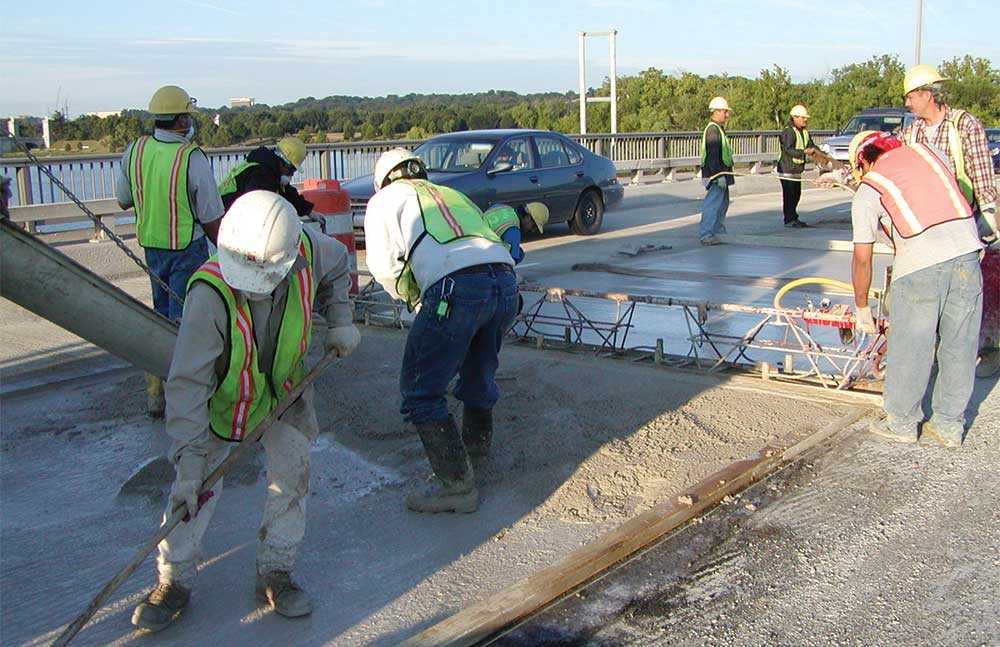
Not all damaged decks need to be replaced. Frequently, the damaged areas can be repaired and an overlay placed on the deck to restore riding quality. Unless the overlay is impermeable, however, chlorides will penetrate the overlay and the deck, and the problem will continue.
Latex-modified concrete (LMC) overlays are relatively impermeable but require a number of days to gain sufficient strength so that they can be opened to traffic. Using Type III cement with the latex (LMC-HE) reduces the delay to one to two days; an improvement but still inconvenient for the public.
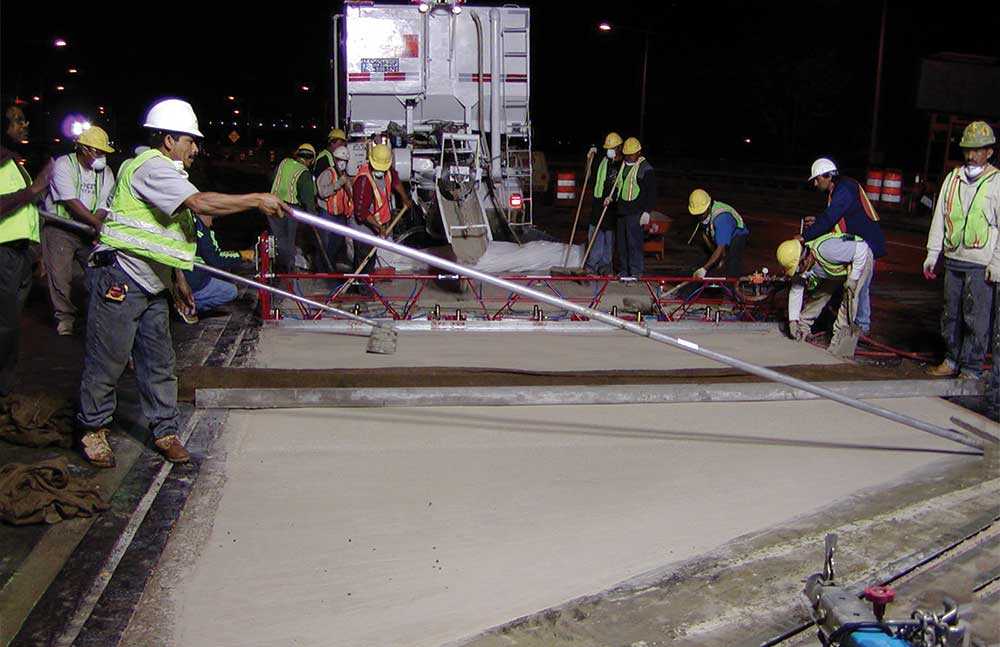
However, a more efficient solution exists that can dramatically accelerate repairs. The prototype was identified and initially tested about 10 years ago. In 1997, the Virginia Transportation Research Council together with the Virginia Department of Transportation placed overlays on two bridges using a very early strength cement dubbed LMC-VE (for Very Early). In both projects, the completed overlays were opened to traffic in three hours. The work was done at night, further reducing the inconvenience to the public. A cost analysis showed the higher material cost was more than offset by the reduction in traffic control costs. An inspection in 2006 found both bridge decks were in excellent condition.
Later in 2006, one of the bridges was taken out of service (replaced with a bridge having greater traffic capacity). Bond pullout tests on core samples including the original deck and the overlay showed that failures were in the original deck concrete; the bond was stronger than the concrete being overlaid. Chloride permeability test results on the overlay were less than 100 coulombs, and the overlay was crack-free.
The very early strength cement used in the overlays was Rapid Set Cement, a very rapid-setting and rapid-strength gain cement that has been widely used for repair/replacement since 1981 in buildings, tunnels, bridges, highways, airports, and chemical plants. Since 1998, Rapid Set Latex Modified Concrete (RSLMC) has been used in several states in approximately 100 bridge overlays.
Wider use of proven technologies that eliminate or reduce concrete cracking in decks (old or new) can certainly reduce the billions of dollars spent annually in the United States on repair or replacement of bridge decks damaged by chloride-induced corrosion.
Edward Rubin, P.E., FACI, is a concrete consultant and was one of the developers of shrinkage-compensating cement (Type K) and concrete in the 1960s. He is a consultant to CTS Cement Manufacturing and can be reached at
800-929-3030 or erubin@CTScement.com.
CTS Cement Manufacturing Corp. is the leading manufacturer of advanced calcium sulfoaluminate (CSA) cement technology in the United States. Our Komponent® and Rapid Set® product lines are renowned for proven performance, high quality, and exceptional service life. Contact CTS Cement for support on your next project.
Call 1-800-929-3030
Original publication: Rubin, E., P.E. FACI. (2007, November). It’s In The Mix. Bridges, 8-10.