Innovations in the concrete construction industry are making the difference between the ordinary and the exceptional in floor quality and durability. Distribution Plus Inc. (DPI), specializing in large food distribution centers, has high expectations for quality in its constructed facilities. That’s why DPI specified shrinkage compensating concrete (SCC) slabs with a traprock surface hardener for a state-of-the-art distribution facility in Upper Marlboro, Md.
The standard of industrial floor that DPI was looking for when it specified this slab was clear, but DPI remained flexible enough to consider new products and systems that might further enhance the finished floor slab’s quality and durability. With this open-minded approach, the contractor, Fricks Floor Systems, had the opportunity to use a combination of innovative products and proven techniques in the construction of this industrial concrete floor.
Based on decades of quality industrial construction experience, Fricks proposed two new products for use that are examples of important innovations in the concrete flatwork industry:
The Diamond Dowel System replaced conventional square dowels and offered improved load transfer and reduced restraint.
Armor-Edge joint assemblies allowed the contractor to install a durable joint detail to exacting tolerances with no welding or grinding. These two product innovations made the difference between a typical industrial floor and one that we feel could be described as the most durable floor in the industry.

Load transfer without restraint
Differential shrinkage in adjacent slabs induces restraint and increases the likelihood of out-of-joint cracking. The Diamond Dowel System, produced by PNA Construction Technologies, is a plate dowel designed to allow for this differential shrinkage. The system uses a combination of the steel plate’s geometry and compressible side fins in the plastic pocket former to ensure that the plate does not restrain lateral movement while still transferring the total vertical load. The original design called for traditional square dowels and clips, but DPI was convinced to use the diamond plate dowels upon learning that Fricks had become advocates of the new system because of its many advantages.
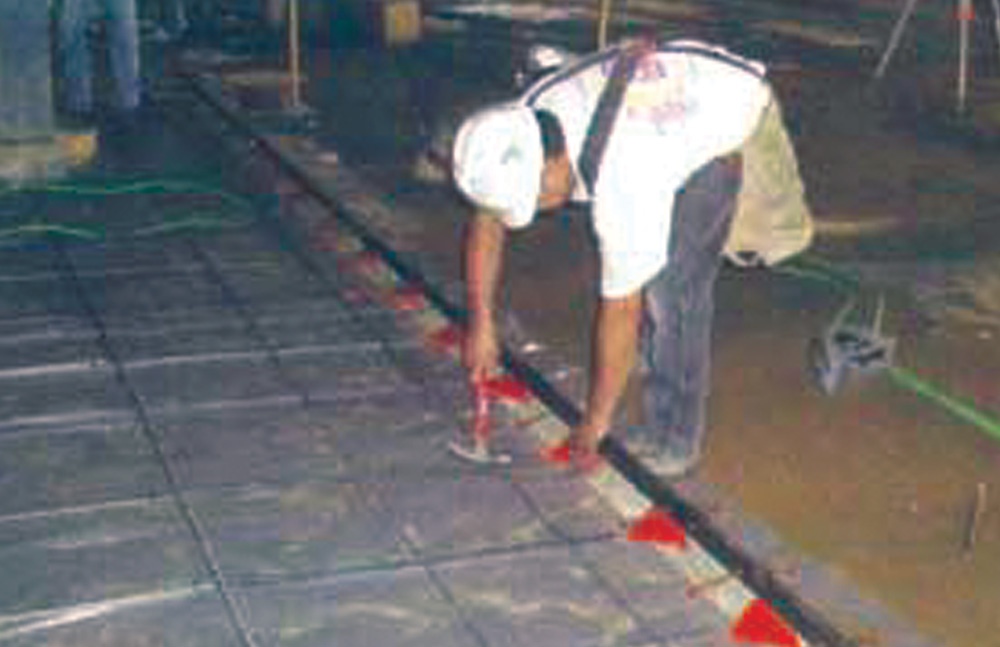
Response of concrete workers
We asked the concrete construction crew what they liked about the diamond plate dowel system over the traditional round or square dowel systems. They replied:
Explaining advantages
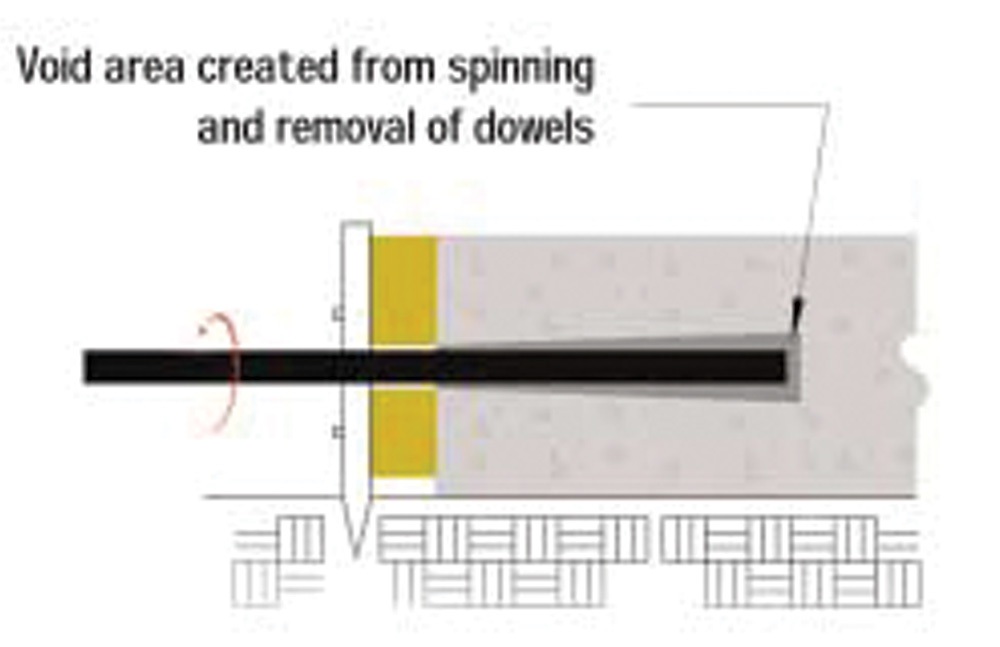
Conventional dowels have to be removed to allow for the removal of edge forms. They then must be replaced before the adjacent slab is placed. Unless workers take extreme care during this operation, they easily can hollow out a cone-shaped hole in the freshly placed concrete, which can reduce the load-bearing capacity of the dowel significantly. The replacement of round or square dowels requires the same care to prevent the green concrete from becoming fractured at the interface of the joint. It is often difficult to explain to site operatives the difference between tapping the dowels back in and beating them back in when production rates are at stake. The new diamond plate dowel eliminates these concerns.
Especially when SCC is used, elimination of slab restraint can be critical. With SCC, the concrete is designed to expand within the first 7 days to compensate for the normal drying shrinkage, then return to its original size. To achieve this we must reduce all restraint caused by subgrade friction or dowels. The diamond plate dowel system eliminates restraint caused by misaligned dowels in construction joints, and it is also minimizes the likelihood of out-of-joint cracking.

Improved joint protection
Joint failure (spalling at the joints) is the most frequent complaint from owners of industrial concrete floors.
DPI recognized the need for good joint protection and specified steel armored joints. The Armor-Edge joint assembly was used for the very first time on this project. This fully fabricated assembly was developed by PNA to improve the tolerances of armored joints, prevent secondary spalling to the outer edge of the steel bars and reduce the labor required for installation.
Response of workers
Some of the comments from the Fricks’ installers about working with the armored joint assembly are as follows:
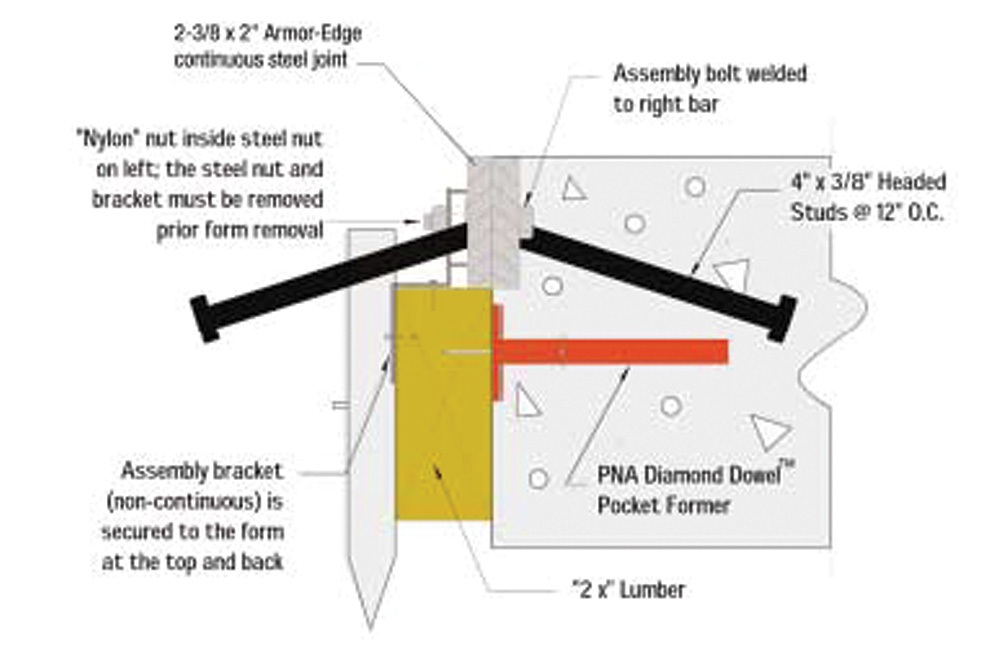
Explaining the edge assembly
The joint assembly is constructed with two cold-rolled steel bars. These bars are flatter and provide a square edge to finish up to. This improved top surface prevents the typical secondary spalling to the outer edge of the bar that often occurs with more conventional site-fabricated armored joints. Hand finishing against the armored edge during the strike-off and initial setting of the concrete ensures the flatness across the joints. This was followed up with trowel machines to achieve the same burnished trowel finish all the way up to the joint.
Site testing and QC
Designs incorporating the use of SCC in slabs can produce exceptionally durable floors. But, in order for these designs to work properly, efforts must be made to ensure that the concrete mix is expanding at the right rate for the reinforcement design. The contractor must understand this importance and be able to test the concrete expansion onsite.
On this project, tests were run on trial mix designs before the start of the project to ensure that proper expansion was achieved and to allow adequate time to react to any problems or concerns that were encountered. Both the ASTM C 878 “Restrained Expansion Test for SCC” and a double-check with the FFS jar expansion test were performed onsite daily to verify that the optimum expansion was achieved.
The necessity for low restraint in SCC slabs means that the subgrade must be extremely flat. With this (and the cost implications of excess concrete yield) in mind, it is our opinion that the fine grading always should be the responsibility of the flooring contractor. On the DPI project, Fricks Floor Systems had to meet a subgrade requirement of ±1/10 foot. The general contractor provided the additional subgrade material needed and was responsible for removing excess material.
Success lies in the details
Concrete will surprise you, and SCC is no exception. As with any industrial floor slab, success lies in the details. Contractors should always be aware of the potential for random cracks and should take steps to prevent them.
Fricks’ site personnel went to great lengths on the DPI project to look for situations that could cause re-entrant cracks and to make sure that additional reinforcement was located to reduce crack potential and, in case cracks did occur, to hold them tight.
The joint layout also was given great attention, particularly where mezzanine columns fell in the middle of pours and didn’t line up with the main building columns. Isolation material and additional reinforcement were placed at these locations.
Summary
This industrial slab was designed to reduce floor joints and cracks. The quality construction methods and innovative products adopted contributed to the project’s success. The owner’s receptiveness to innovation and high expectations translated into a finished industrial slab that is flat and durable not only at the center of the slab but also at the joints. These innovative products and attention to detail will reduce future maintenance and repair costs for both the slabs and the equipment they carry for the life of the facility.
PROJECT PARTICIPANTS
Owner: Distribution Plus Inc. (DPI), Upper, Marlboro, Md.
General Contractor: Williams Construction, Gaithersburg, Md.
Industrial Concrete Floor Contractor: Fricks Floor Systems, Fort Worth, Tex.
Concrete Supplier: Chaney Enterprises, Waldorf, Md.
Products Supplier: PNA, Inc. Mathews, N.C.
Written by: Greg K. Fricks and Nigel K. Parkes. Greg K. Fricks, vice president of Fricks Floor Systems, Fort Worth, Texas, is in charge of field operations and quality control and has more than 18 years of experience in the construction of industrial floor slabs on ground.
Nigel K. Parkes, Vice President of PNA Construction Technologies, Matthews, N.C., has worked for PNA for over 14 years.
For information on PNA, call 800-542-0214, visit www.pna-inc.com on the Web.
CTS Cement Manufacturing Corp. is the leading manufacturer of advanced calcium sulfoaluminate (CSA) cement technology in the United States. Our Komponent® and Rapid Set® product lines are renowned for proven performance, high quality, and exceptional service life. Contact CTS Cement for support on your next project.
Call 1-800-929-3030
Original publication: Fricks, G., and Parkes, N, (2002, January). Article published in Concrete Construction, The World of Concrete, January 2002 by Hanley-Wood Publication.