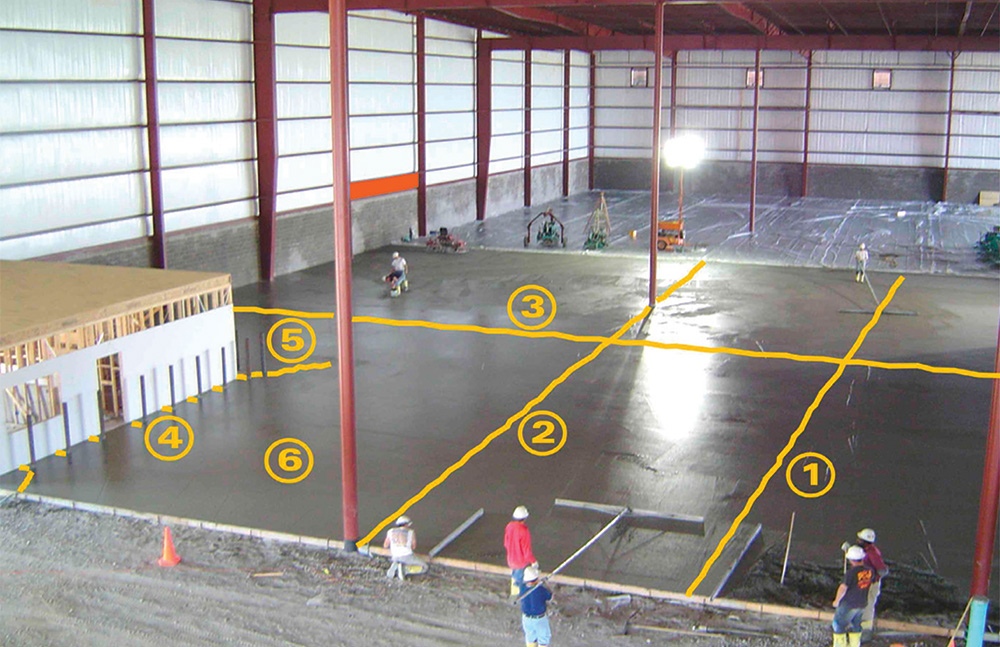
This picture looks just like countless slabs on countless projects. But this slab is very different because:
It is 110 ft. x 130 ft.
It was not saw cut.
There is no steel reinforcing.
There are no cracks.
It has an FF (floor flatness) of 98.6.
This very special slab was placed at Sofa Express in Portland, TN using System-K™ by CTS Cement Manufacturing, Cypress, CA. System-K includes shrinkage-compensating cement and K-Fiber™. The contractor was Thessen Concrete Contracting of Bowling Green, KY. Perry Thessen, who has placed many slabs with shrinkage-compensating concrete says, “There’s no comparison between a shrinkage-compensating concrete floor and a conventional floor. Conventional floors have a lot of joints and can curl and crack, but a shrinkage-compensating concrete floor doesn’t have those problems.”
Shrinkage-compensating cement has been used in thousands of slabs in the United States over the past 40 years. Unlike portland cement concrete, which shrinks as it dries, shrinkage-compensating cement expands, counteracting the natural drying shrinkage. That’s why joints can be minimized or eliminated and why there are few, if any, cracks. The fibers, which prevent the concrete from expanding too much, are small proprietary plastic fibers that are invisible to the finisher. Thessen says that “working with System-K concrete is just like working with conventional concrete. The fibers weren’t evident, as they usually are in other fibrous concrete.”
Where would this slab normally crack? Check out the photo to the left.
Mid-panel (1): One would definitely expect a 110x130 foot panel to have cracks on the centerline and other places as well, but with System-K that is not a concern.
Column lines (2): There are no cracks at the column lines and both box outs, and saw cuts are eliminated. All that is required is a foam wrap, as can be noted on the nearest round column.
Perimeter columns (3): Again, no boxouts, no sawcuts, and no cracks.
Bollards (4): Typically a crack forms at bollards running out to the edge of the slab, but not here.
Re-entrant corners (5): There is almost always a crack running off at 45 degrees on traditional jobs.
Plastic shrinkage cracks and crazing (6): These cracks will be nearly non-existent due to the K-Fiber.
Kyle de Bruyn of CTS Cement says, “I inspected the entire slab on hands and knees 8 weeks after placement searching for cracks. There were none. The owner is so pleased that he has already committed to do his next project, which is 300,000 square feet, with Thessen Concrete and System-K.”
Other benefits of this system are:
The slab can’t curl at the edges because of the weight and dimentional stability of the slab, so it just stays flat. Five weeks after placement, the FF on this slab was 98.6, which corresponds to a flatness of about 1/16 inch in 10 feet, and the FL (floor levelness) was 61.0.
ACI 223, “Standard Practice for the Use of Shrinkage-Compensating Concrete,” notes that the “abrasion resistance is 30-40 percent higher than portland cement concrete.”
ACI recommends a maximum panel length-to-width ratio of 1.5 to 1, but it can be as high as 3 to 1 with System-K™.
There is almost no spalling at the joints because there are almost no joints.
Although there is an additional material cost for System-K concrete, the overall savings quickly cover the cubic yard cost due to the savings in reduced rebar, welded wire fabric, dowel baskets, saw cutting, joint filling, and lifting and pulling steel on job day. There is also no need to fill the joints to cast tilt-up panels on the slab, no steel to slow down the laser screed, and almost no spall, crack, and curl repair required.
The contractor saves time, labor and money, and the owner gets a better, more maintenance-free floor.
Written by: Dave Flax,
CTS Cement Manufacturing Corp.
CTS Cement Manufacturing Corp. is the leading manufacturer of advanced calcium sulfoaluminate (CSA) cement technology in the United States. Our Komponent® and Rapid Set® product lines are renowned for proven performance, high quality, and exceptional service life. Contact CTS Cement for support on your next project.
Call 1-800-929-3030
Original publication: Flax, D. (2004, December). Slabs With No Steel...No Sawcuts...No Cracks. Concrete Construction, 90.
PROJECT HIGHLIGHTS
Sofa Express chose a System-K™ fiber reinforced shrinkage-compensating concrete floor system to achieve long-term dimensional stability of the designed floor flatness and significant savings in maintenance and repair costs.
• Project Scope: New 70,000 square foot warehouse located in Portland, TN.
• Slab Dimensions: 110 feet x 130 feet
• Joint Spacing: At 130 feet with no saw cut control joints
Curing: 7 day wet cure to achieve maximum strength gain and expansion of the shrinkage-compensating cement
Reinforcement: K-Fibers with minimal steel reinforcement to prevent drying shrinkage cracking
Placement: Traditional ready-mix discharge. Limited steel reinforcement eliminated the need for pumping and allowed laser screeds to more easily maneuver around the placement.
Finish: Smooth trowel finish. Micro-fibers were not visible on the finished surface.•
FF/FL: Excellent floor flatness and levelness numbers were achieved, averaging FF of 98.6 and FL of 61.0. At the 8-week post-placement inspection, no cracks were found in the slab.