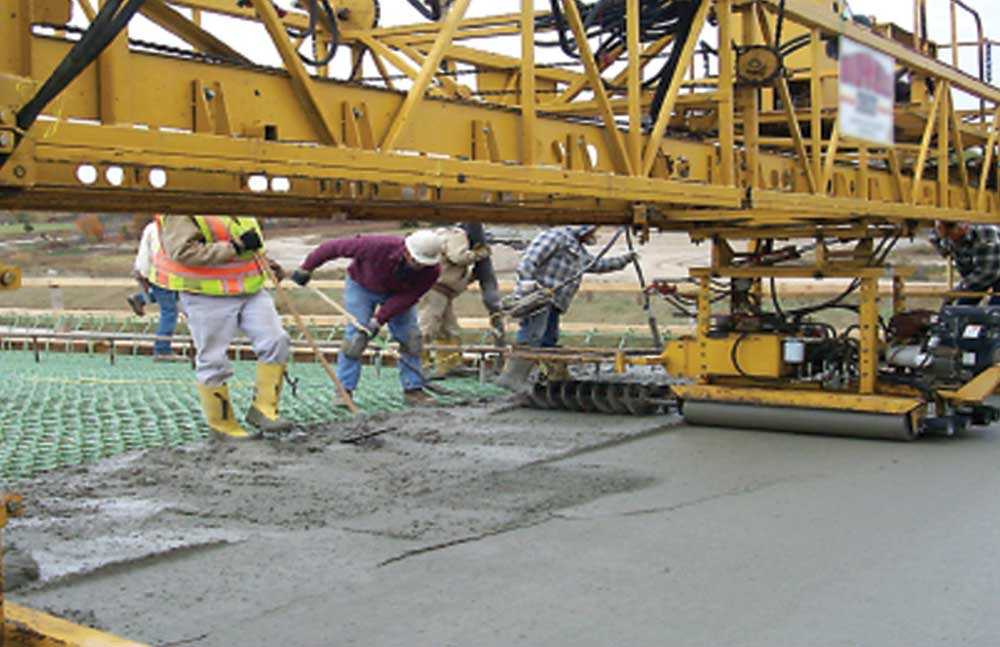
Selecting the cement to be used in a concrete can have a lasting impact on the life span of new concrete bridge decks. One option that is underspecified but has a host of proven results is special cement. There are many situations in which these cements can help extend the useful life cycle of concrete bridge decks.
Indeed, most of the almost 350,000 concrete bridges in the country have concrete decks that develop avoidable premature cracking due to initial shrinkage soon after the pour. While the useful life of structural concrete can exceed 50 years, premature cracking on these outdoor installations frequently warrant early repair.
PREVENTING AND REDUCING CRACKING
The maintenance costs associated with concrete deck surfaces is a large portion of the nearly $8 billion spent annually repairing, rehabilitating, strengthening, and waterproofing bridges and bridge decks. If the specifiers would use mix designs that help make the hardened concrete more durable in the first place (e.g. shrinkage-compensated concrete for new construction) much of the need for deck repair could be reduced.
Research conducted recently at the University of Kansas supports the conclusion that cracks in concrete are the major source of entry of chlorides. Test results show that where cracks occur, the average chloride concentration at a depth of 3 inches can exceed the corrosion threshold (1 lb/cy) of uncoated reinforcing steel within one year.
After two years, the threshold will be exceeded in most decks. Yet away from cracks, at a depth of 3 inches, the chloride concentration is less than the corrosion threshold even after a dozen years. The research also showed that chloride concentration increases as the bridge deck ages.
There is a solution to this problem – a shrinkage-compensating cement that can offset the tensile stresses caused by shrinkage. Properly performed repairs can extend the useful service life of concrete. The most effective way to help ensure durable concrete bridge decks is to eliminate cracking of the concrete from drying shrinkage. This results in tensile stresses when the concrete still has little or no tensile strength.
One method for this effective repair is to incorporate a specialty cement which has been available since 1963. The product has an initial cost somewhat higher than portland cements predominately used for concrete bridges and bridge decks. But the lower life cycle cost due to reduced maintenance and repair over the long-run would more than compensate for any increased construction costs.
The specialty cement combines an expansive chemical component with traditional portland cement. When it cures, the concrete expands slightly initially but then, as the concrete is bonded to the reinforcing steel, it stresses the steel to a degree. This tension (as per Newton’s 3rd law that every action has an equal and opposite reaction) places the concrete in compression.
TYPE K CEMENT
In compression, the hardened concrete can resist the tensile stresses from shrinkage. When the concrete later shrinks, the compression is relieved. However, at the same time, the concrete has developed enough tensile strength to resist the tensile stresses put upon it from shrinkage. This product is referred to as a shrinkage-compensating cement, which is recognized in ASTM C845 as Type K cement. Concrete containing Type K cement is called shrinkage-compensated concrete.
Though shrinkage-compensated concrete requires slightly more water than portland cement concrete (PCC) to hydrate the expansive material, it does not bleed. This eliminates water channels to the surface. The combination of no cracks and no bleed water channels results in low chloride permeability and, therefore, longer life.
Over the past 40 years, shrinkage-compensated concrete has been used in millions of cubic yards of concrete with excellent results in a very broad range of installations. Although it cannot guarantee total freedom from cracking, any cracking will be less frequent and less severe.
Since 1985, the Ohio Turnpike Commission has used Type K concrete decks for all of its new bridges and replacements. Since then, several other states have used Type K cement for bridge decks, including Michigan, Indiana, and Pennsylvania. And in 1995, it was used in a new bridge that was built in Barstow, Calif.
REDUCING DELAYS
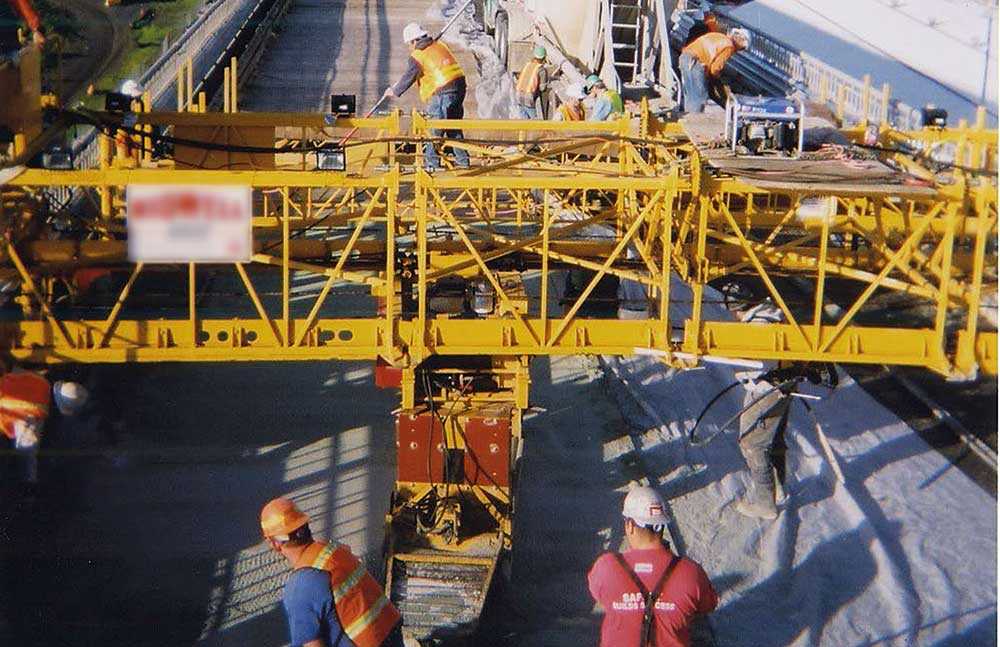
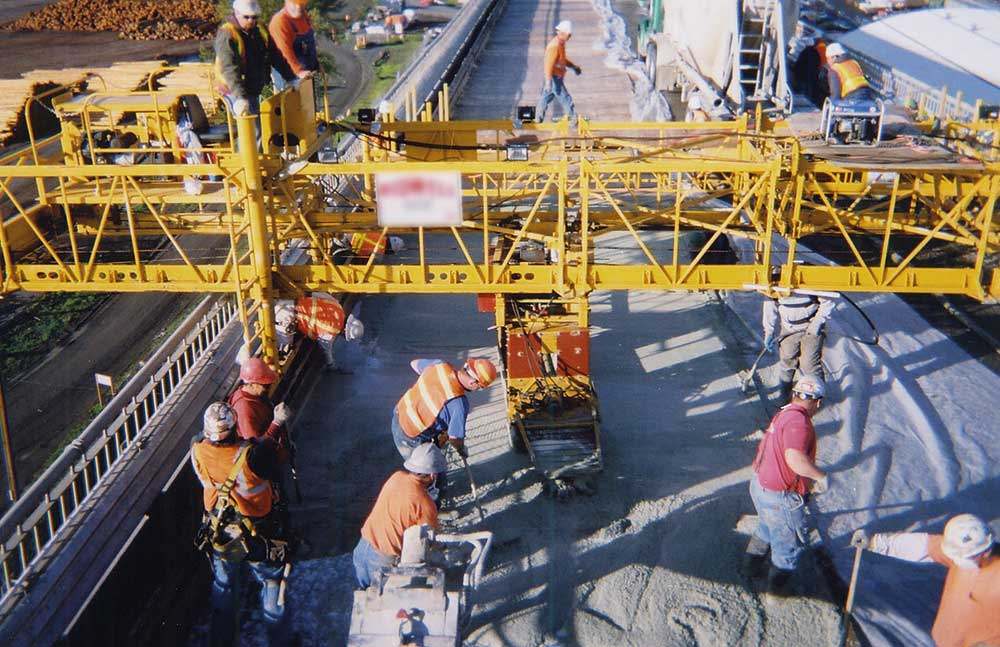
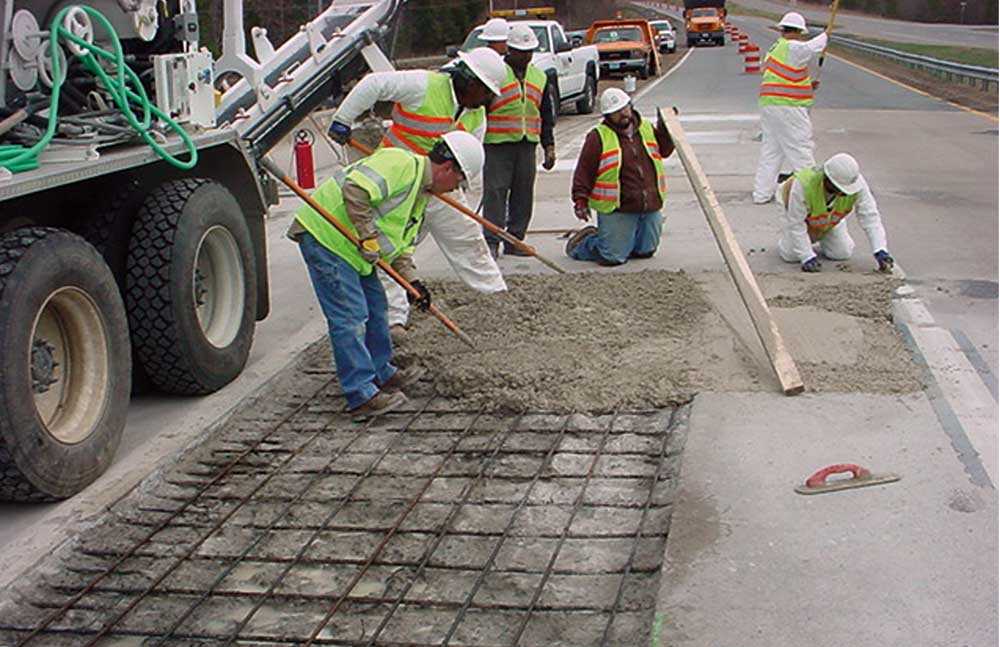
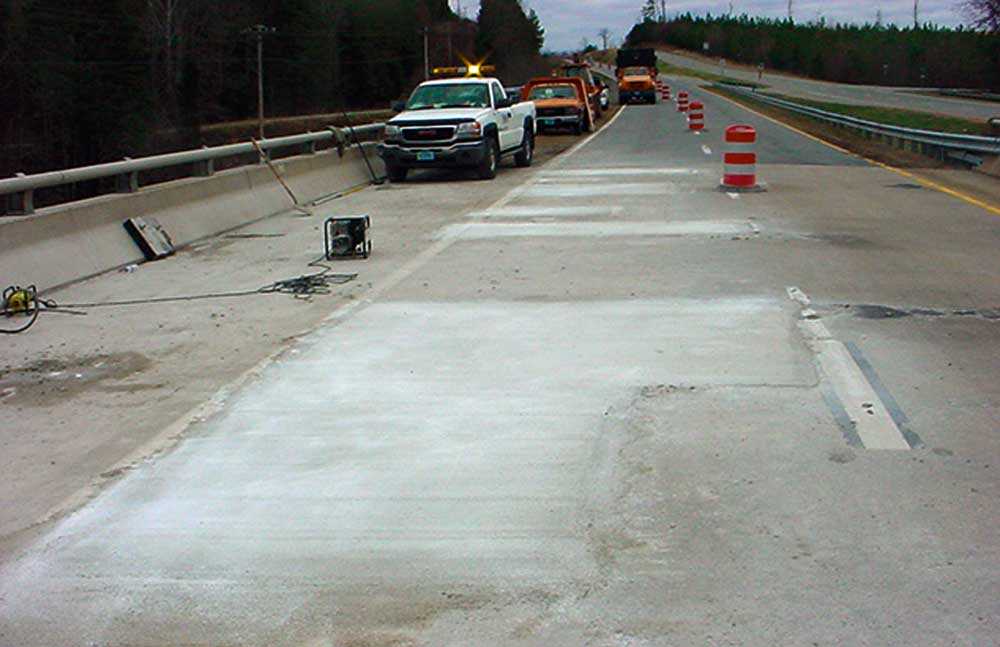
Repairing a damaged concrete deck with a concrete that includes a special rapid-setting cement is an effective tool for concrete contractors. In many cases, its use can allow traffic back on the deck within hours after the pour.
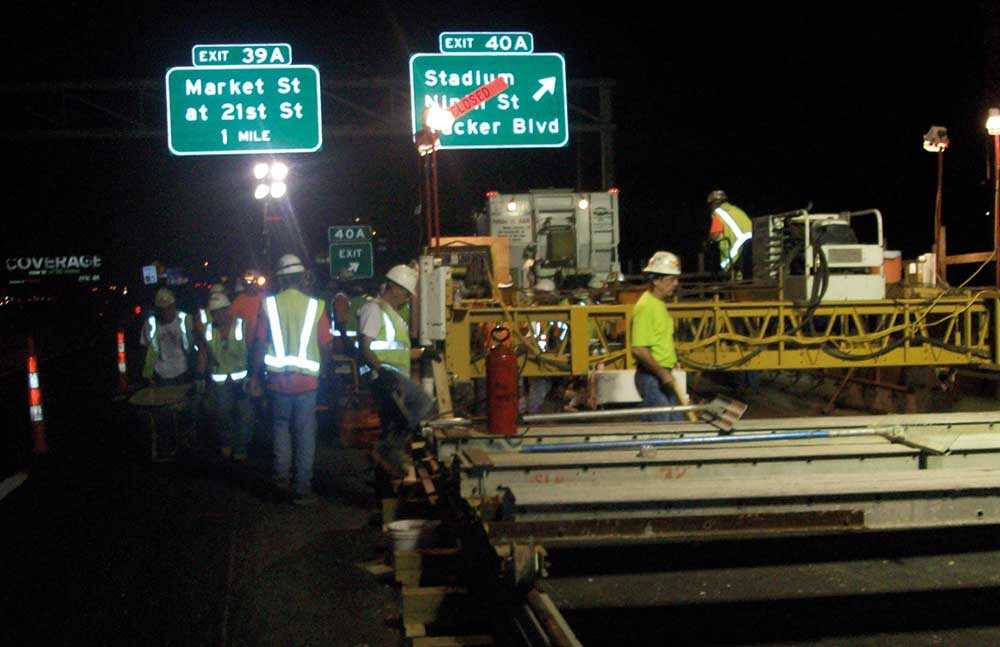
For example, when the deck of a viaduct in New York City had structural damage, the emergency repair contractor was notified at 11 a.m. The contractor re-moved the damaged concrete and debris, set a form, replaced rebar, poured rapid-setting concrete at 5:20 p.m., and opened the lanes to traffic at 7:10 p.m.
One such product, Rapid Set Cement, overcomes the set time limitations of latex-modified concrete (LMC) overlays. LMC overlays are relatively impermeable to chlorides but require several days to gain sufficient strength to be able to sustain traffic. Type III cement with the latex (LMC-HE, for high early) reduces the delay but still requires one to two days before the road is ready for use.
Rapid Set Cement (or LMC-VE, for very early latex-modified concrete), is a very rapid-setting and rapid-strength-gain cement that was developed specifically to capitalize on a chemistry that allows it to set extremely quickly.
When the Rapid Set combines with water (hydrates), it forms crystalline compounds much faster than compounds in portland cement form when combined with water. In addition to shrinking less than portland cement, it gains strength much faster, allowing traffic back on the road quicker.
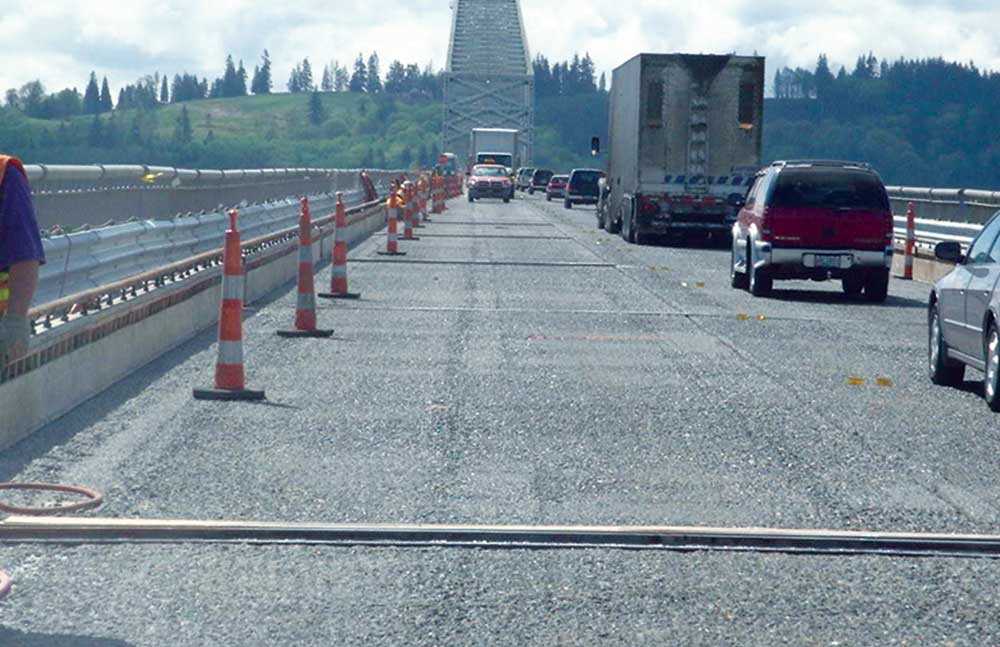
Rapid Set Cement has been used widely for bridge deck overlays. For example, it enabled a contractor to speed through refurbishing much of the surface of the Lewis and Clark Bridge, which dates back to 1929 and connects Rainier, Ore. and Longview, Wash.
REDUCING DELAYS
Though some sections of the deck had to be completely replaced and required partial closures for 18 months, the Washington State Department of Transportation (WSDOT) was keen on keeping closures to a minimum. By using 450 cubic yards of Rapid Set Cement concrete for a 1575-foot overlay during one weekend, WSDOT was able to save at least nine days of closures, compared to using traditional slower setting concrete.
A few years ago, the product was also used for resurfacing the main interstate bridge connecting Interstates 70, 64, and 55 across the Mississippi River in downtown St. Louis. The Missouri DOT was concerned that the surface repairs not disrupt major league baseball at the new Cardinals’ baseball park nearby.
The fast set time of the cement enabled start and completion of the entire resurfacing job between Friday evening and noon Sunday, when there were no home games.
When a bridge which used LMC-VE for overlays in 1996 (under the auspices of the Virginia Transportation Research Council and the Virginia DOT) was decommissioned last year and replaced with a bridge offering higher traffic capacity, bond pullout tests conducted on core samples that included both the original deck concrete and the overlay failed in the existing deck concrete.
The LMC-VE bonded to the base concrete was superior to the concrete that was overlaid. Chloride permeability tests on the overlay passed less than 100 coulombs. Earlier in 2006, an inspection of overlays on the two bridges had shown both were in excellent condition.
© Copyright 2007, Edward H. Rubin, P.E. FACI. First serial rights and a non-exclusive right to reprint are offered to Concrete Surfaces in accordance with terms of correspondence.
Written by: Michael Chusid, RA FCSI. Edward H. Rubin, P.E., FACI is a concrete consultant, and was one of the developers of shrinkage-compensating cement (Type K) and concrete in the 1960s. He is a consultant to CTS Cement Manufacturing Corp. (www.CTScement.com). Telephone 800-929-3030 or e-mail erubin@ctscement.com.
CTS Cement Manufacturing Corp. is the leading manufacturer of advanced calcium sulfoaluminate (CSA) cement technology in the United States. Our Komponent® and Rapid Set® product lines are renowned for proven performance, high quality, and exceptional service life. Contact CTS Cement for support on your next project.
Call 1-800-929-3030
Original publication: Rubin, Edward H., P.E. FACI. (2007, Winter). The Need for Speed: Special Cements Allow for Quicker, Long Lasting Concrete Bridge and Deck Repairs. Concrete Surfaces, 26-29.
WHY CONCRETE DECKS CRACK
Because bridge decks are exposed on top and bottom, they ice up faster in the winter and are often treated with deicing salts and/or other aggressive chemicals to keep the surface free of snow and ice. Concrete shrinks as it dries and hardens, leading to the formation of drying shrinkage cracks. These provide a path for chloride ions to reach the reinforcing steel.
Concrete has a pH of about 11-13. In response to contact with such a highly alkaline material, reinforcing steel develops a passivating film that protects it against corrosion. But, if chlorides entering the concrete via cracks and water channels (occurring from bleeding of excess water) reach the steel, the protective film may be destroyed, which in turn allows corrosion to begin.
The products of corrosion take up a greater volume than the constituents. An internal pressure develops, eventually leading to cracking and spalling of the concrete cover above the steel. This reduces the bond and anchorage of the steel to the concrete, negatively impacting the structural properties of the deck and its contribution to the bridge structure.
To minimize the need for early bridge repair, that corrosion must be prevented.
Though suitable without reservation for many applications, portland cement concrete (PCC) has an underlying limitation when used for roads and bridges that contributes to the need for repairs: It shrinks as it dries. Shrinkage is the bane of longevity of a reinforced concrete bridge deck because it eventually leads to corrosion of the reinforcing steel.
Although some of the shrinkage is due to hydration products forming, most is a result of the bleeding of excess water. Portland cement requires a w/c ratio of only about 0.22 for complete hydration. However, the ability to place the concrete where it needs to go requires about twice that. The bleeding of the excess water is a loss of some volume and leaves voids both in the mass and in channels to the surface.
As the PCC hardens and shrinks, tensile stresses develop, caused by restraint from reinforcing steel, forms, aggregate interlock, and other factors. While the concrete is still relatively fresh, the tensile strength is practically negligible. Therefore cracks develop as a result of the shrinkage stresses.
The special blended cement required for theLMC-VE costs four times that of Type I/II cements used in conventional LMC overlays. The Type III cement used in the LMC-HE costs 20% more than Type I/II cements used in the conventional LMC overlays.
The higher prices of the cements increase the cost of the concrete by about $90 per cubic yard and $7 per cubic yard, respectively. But the substantial savings in the lower cost of traffic control more than compensate for the added costs.
The costs for traffic control for LMC-VE over-lays and for epoxy overlays are the same. LMC-VE overlays can run about 25% less than conventional LMC overlays. DOTs spending $5 million annually on deck rehabilitation can save as much as $1.25 million using LMC-VE overlays.