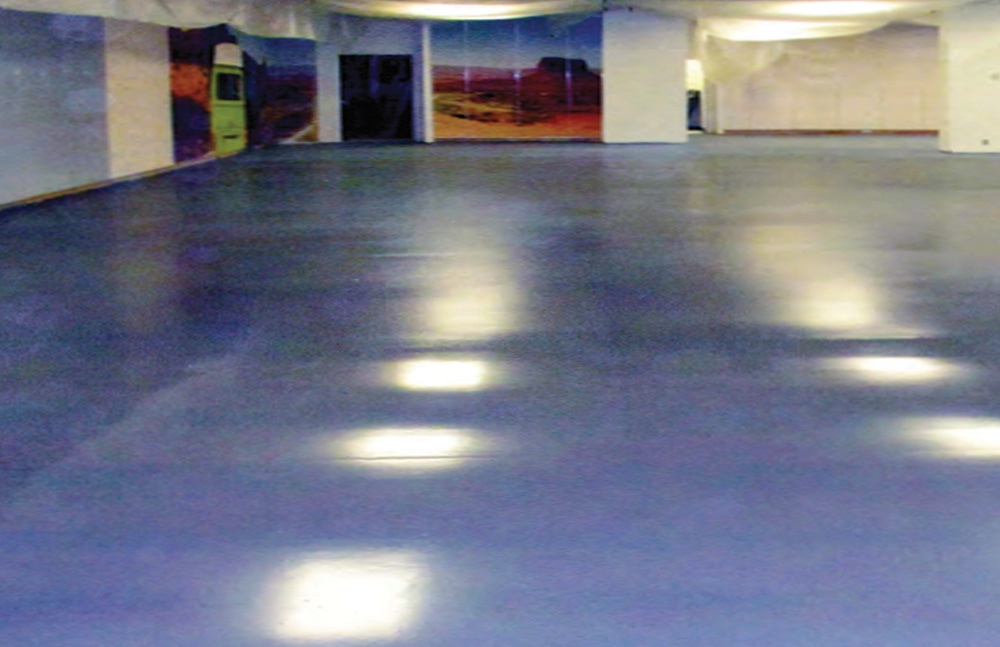
Polishable overlay is a problem solver and a creative magic wand. A thin layer of one of these self-leveling cementitious mixes can be poured on new or existing concrete, transforming it into a new floor. It can be integrally colored – even multicolored to create designs – dyed and stenciled to create art or graphics and then polished to a high gloss.
The decorative options available with a polishable cementitious overlay can turn a damaged, ugly floor into a completely different surface. The overlay offers an easy solution to make the floor designable, for both decorative and functional effects. It has a unique visual character that can be creatively enhanced in a variety of ways, and it can be gorgeous. The overlay may be thin, but the look is rich.
THE DISCOVERY
Self-leveling underlays saw a burst of technological advancement a few years ago. It was soon discovered the new materials could be used as overlays that were hard enough and sufficiently well-bonded to the substrate to be polished. The fundamental process is the same as concrete polishing, but the versatility of the overlay takes it to a new level.
At first, overlays were used primarily on existing, badly damaged or patched concrete slabs. Then, designers and contractors realized the material’s unique properties and began applying it over new floors just to reap its aesthetic abundance.
The look is different from concrete – fine grained, without coarse aggregate. It can be integrally colored, an option that yields more consistent, less variegated effects than any of the colorants (dye, stain) that are applied to cured concrete. In concrete, integral color can only be mixed into a new pour, but that’s what the overlay is: a new, freshly poured (but thin) concrete floor.
There are a variety of overlays on the market, some based on portland cement, others on specialty cements such as calcium sulfoaluminates. They all tend to cure very quickly, most attaining polishable strength in 72 hours or less. Both of the specific projects discussed here used CTS Cement’s Rapid Set TRU Self-Leveling, an advanced hydraulic cement-based, selfleveling topping, resurfacer and underlayment. This article will use that product’s specifications and properties as examples. Other products vary – but not widely – as to setting time, curing time, color, minimum and maximum thickness, etc.
THE BASICS
Whether the concrete substrate is new or old, preparation is similar. The surface should be clean and free of oils, curing compounds or other potential bond breakers. Crumbling or unsound concrete should be removed and patched. The same overlay is often used as the patching compound. Surface should conform to ICRI CSP 3-5 with mechanical surface preparation methods, such as shot blasting, preferred. Acid etching is not recommended.
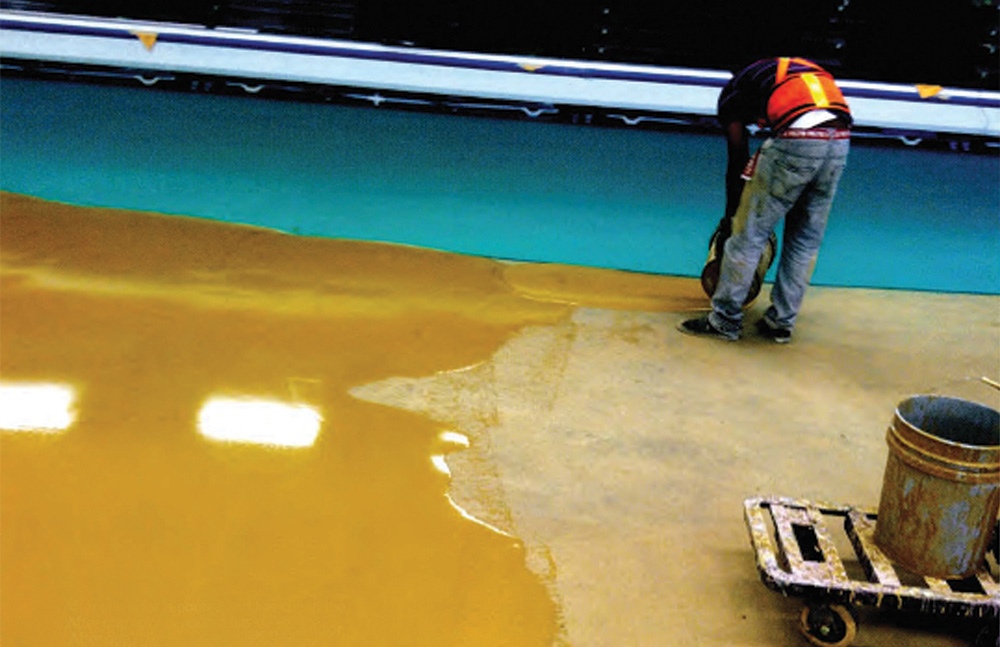
The concrete is primed with an epoxy that seals it, preventing it from stealing moisture from the overlay: a proper water/cementitious material (w/cm) ratio is critical to overlay performance. For floors with high moisture levels, a moisture-insensitive epoxy is needed.
Sand is broadcast to refusal onto the wet epoxy to provide a mechanical key for overlay bonding. Once it cures, excess sand is removed and the overlay can be poured on.
The overlay can be poured up to 1 ½ inches thick in its pure state or even thicker with the addition of pea gravel aggregate. When extending with pea gravel, the top ½ inch should be applied as a separate pour of pure overlay. The overlay can be as thin as 5/16 inch over the highest spots on the substrate. The typical thickness for many polishing projects is 3/8 inch to ½ inch.
The overlay attains 3,000 psi compressive strength within 4 hours, and 5,000 psi within 24 hours. At 28 days, it attains 6,500 psi. By contrast, ordinary portland cement (OPC) concrete designed for a single-family residential slab in a mild climate is often specified at 2,500 psi at 28 days.
Opinions vary as to when it’s safe to begin grinding and polishing. Some polishers will begin to grind the next day, others wait as long as 72 hours. In any case, it’s nothing like the 28-day wait for new concrete.
When TRU cures, it forms a tough polymer skin on the surface that is removed with an aggressive grinding step (25- or 40-grit metal bond diamonds) to begin the polishing process. Then the polishing – a sequence of progressively finer abrasives – can be followed to achieve the specified finished gloss level.
Densifier is applied after the 200-grit grind.
Since the chemistry and density of overlays are different from concrete, densifiers formulated for concrete – which is to say, most densifiers on the market – may not react properly. Overlays based on non-portland cements have less calcium hydroxide (lime) as a byproduct of hydration. Concrete densifiers are formulated to react with lime, as it appears in concrete matrix, so they may not react as completely. Overlays also tend to be more dense than concrete, making conventional densifiers less able to penetrate. Use a densifier that is approved as compatible by the overlay manufacturer or is formulated specifically for overlays, such as AmeriPolish OS Densifier. It is engineered with molecule size distribution optimized for overlay density and increased reactivity, so it penetrates effectively and is able to take advantage of the small quantities of calcium hydroxide· present.
COLOR ME VERSATILE
If a cream-colored floor with very smooth visual texture is desired, then no color is needed. Pour, density, polish and stain protect - that’s all.
For any other project, overlay floors excel at color.
The option of integral color is a tremendous advantage. Since it’s mixed into the material, there are no issues with uneven penetration and absorption. The color saturation is more consistent than dye, and very rich color is possible. The color becomes a permanent part of the concrete, and the pigments used are considered stable and non-fading. It polishes beautifully.
Again, the overlay is not concrete, and materials designed for concrete may or may not perform as expected. An exception is AmeriPolish OS Integral Color, a recently introduced product designed for overlays and approved by the manufacturer of TRU. It is a liquid colorant, packaged in quantities to dose whole bags of the overlay powder: one package of colorant equals a 2-percent dosage in one 50-lb bag of overlay. Dosage can be increased up to 4 percent to achieve darker saturation.
Color is added to the overlay powder, along with the specified quantity of water, and mixed according to manufacturer’s directions. Then it’s poured and spread. Unlike integrally colored concrete, the overlay does not require wet curing and does not need to be covered. This avoids color shift issues that sometimes occur with concrete from uneven moisture on the surface where plastic touches or does not touch the slab.
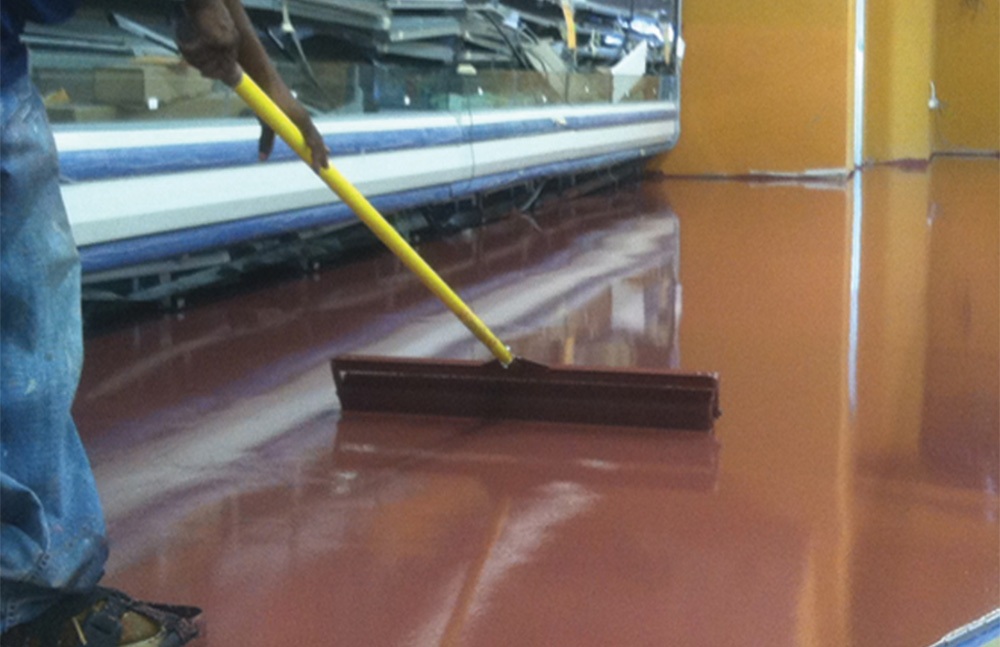
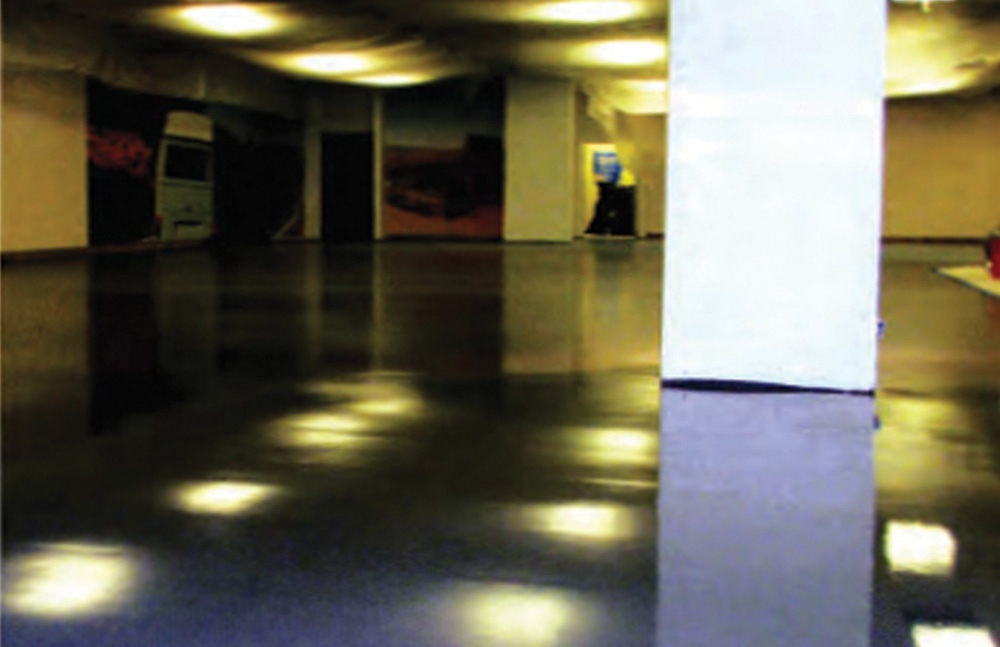
The creative part comes in the pouring. A supermarket project in Trinidad is a prime example of multicolor design using integrally colored overlay.
The contractor laid out the different colors on the floor by making low-profile dams to pour against. This “formwork” consisted of nothing more than adhesive- backed foam insulating tape, stuck down to the substrate.
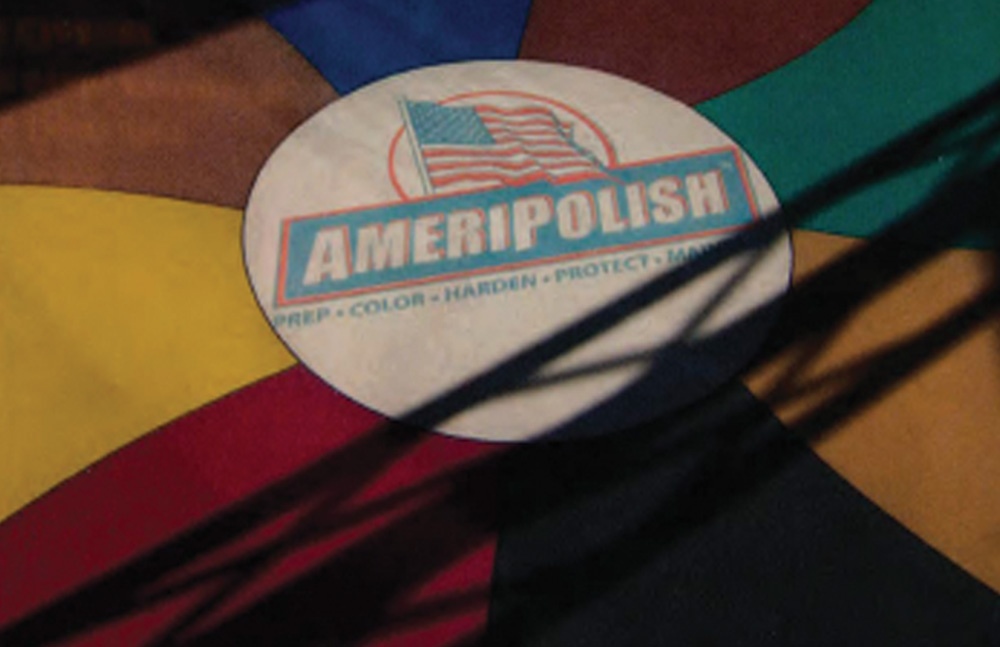
Lines, curves and even a checkerboard were laid out. The TRU overlay, brightly colored with AmeriPolish OS integral colors, was poured and spread up against the dams. Once cured, the dams were removed and adjacent sections were poured, butting up against the first pour. The lines came out clean and the curves smooth. The entire project was done over a period of about three weeks. The store opened the day after it was finished.
The design and colors of the store go beyond decoration for its own sake. Different colors are used to market different types of products. Red floor, for example, enhances the appeal of the meat counter. Blue tells shoppers they’re in the frozen food section. The red and white checkerboard makes the liquor aisle unforgettable. The curves neatly segue one section into the next and provide a sense of wayfinding.
It’s easy to see how this technique can yield a wide range of effects. Something as complex as stained glass is conceivable, given a contractor with enough skill and patience.
MORE COLOR
Plain or integrally colored·overlay can also be enhanced with dyes surface-applied after the overlay has cured. It can be used to deepen integral color, to tint it or as contrast. It can be added to the entire floor or applied selectively by masking.
As with dyeing concrete, penetration is important for getting the desired color saturation and for the durability of the color. The difference is that overlays have a much tighter pore structure than concrete. Conventional concrete dyes, based on acetone or water as solvent, will often be refused by overlays.
Dye has been developed specifically for overlays, using a high-penetration solvent. AmeriPolish OS dye is based on a non-flammable, low-VOC proprietary solvent with better penetration than acetone. Because of its unusual penetration, it is not applied at the same point in the process as conventional dye on concrete. In concrete polishing, dye is applied before densifier. Using the specialty dye on overlay, it is applied after the densifier and after the 800-grit polishing phase.
This specialty dye can also be used on extremely tight concrete slabs that refuse conventional dyes. At World of Concrete 2013, some of the fast-setting slabs placed in the outdoor Decorative Concrete area were extremely tight, and the highpenetration overlay dye was in demand to solve coloring problems.
A custom residence in Coral Gables, Fla., displays an appealing use of the combination of integral color and dye.
The color sample given to the contractor was a piece of dark blue stained glass that proved challenging to match. The contractor sought help from the manufacturer. The solution proved to be a combination of 1-percent dose of AmeriPolish OS integral black, followed by AmeriPolish OS blue dye.
The house was 55 years old and the existing floor had previously been floored with terrazzo, then marble, then granite. The substrate was a mess.
The contractor shot-blasted down to sound concrete. He sealed the concrete with a coat of moisture-insensitive epoxy without sand, then a second epoxy coat with sand. The overlay was poured and allowed to cure over the weekend – although this contractor reports that he has sometimes begun to grind after as little as 12 hours with good results. He used HTC SF 40-grit soft-bond matrix diamonds to cut through the skin and then KGS Swiflex RD diamond discs to complete the polishing process, finishing with 1,500 grit. The discs are a new type of resin-bond tool that produce excellent refinement, making high-gloss floors easier to attain. The contractor reported gloss meter readings in the high 70s.
The result is a lustrous blue-gray surface that 1s highly reflective, acting as a canvas that presents the home’s furnishings and exterior views. The floor mirrors all the colors against a deep background, a dark alternative version of the surroundings.
Dyes can be sprayed on broadly or applied with precision using stencils. The virtually limitless possibilities of stenciling are beyond the scope of this article. Lasercut stencils can produce anything from broad designs to halftone-like photographic images.
Finishing the touches
As with most colored cementitious floors, stain protection is strongly recommended by the manufacturer. The surface can absorb staining agents, and acidic substances (including many food substances) can etch it, both discoloring and comprom1s1ng the polish.
AmeriPolish OS Stain Protector, the product used in both these projects, applies a thin, breathable polymer layer that provides a window of opportunity to clean spills before they cause permanent damage. Spills should be cleaned within one half-hour if possible, to avoid penetrating the stain protection layer. Contractors should always follow the manufacturer’s instructions for stain protection application. Applying too much stain protection can result in a “surface coated floor” and will not meet the requirements of CPAA’s definition of polished concrete.
It’s also important to educate owners about stain protection. Most stain protectors on the market are used as a sacrificial layer. They must be renewed periodically, or they will eventually fail. Typically, stain protection should be re-applied every two years, more frequently in high-traffic areas. Polishing professionals should stay in touch with their customers and periodically evaluate the condition of stain protection.
The service life of some stain protectors can be extended by using a matching, replenishing cleaner. AmeriPolish OS Stain Protector, for example, has a matching Rejuvenating Cleaner that acts to bolster the stain protector if used on a regular basis. A well-polished and properly protected floor can give long service and continue to look gorgeous for years, even decades.
Written by: Steve Miller. Steve Miller is a writer for AmeriPolish. He can be reached at steve@metaphorce.com.
CTS Cement Manufacturing Corp. is the leading manufacturer of advanced calcium sulfoaluminate (CSA) cement technology in the United States. Our Komponent® and Rapid Set® product lines are renowned for proven performance, high quality, and exceptional service life. Contact CTS Cement for support on your next project.
Call 1-800-929-3030
Original publication: Miller S. (2013, Spring). Thin & Rich: Polishable Overlay Offers New Floor Options Quickly and Affordably. Concrete Polishing Association, 10-16.