Data centers are among the most demanding structures being built today and at hyper speed. As these mega-scale projects push the limits of scale, speed and sustainability, design and construction teams are challenged to develop more efficient approaches to how they work. Nowhere is that shift more visible than in structural concrete design, where next-generation approaches are now essential to deliver facilities built for today's requirements and tomorrow's growth.
For structural engineers, concrete designs must deliver capacity for increasingly concentrated equipment loads with unknown future loads as server technologies, cooling systems, and racking systems evolve. Accelerated schedules and demanding uptime expectations make construction efficiency and minimizing repair and maintenance essential.
To meet these demanding and dynamic requirements, shrinkage-compensating concrete is setting the standard of excellence in data center designs. Its use provides a wide range of solutions that address key challenges in structural concrete. Namely, increasing capacity of the slab to address future equipment loads, improving dimensional stability and durability to prevent repairs and disruptive maintenance, improving construction efficiencies, reducing construction costs, and improving sustainability – all without sacrificing performance.
Type K shrinkage-compensating concrete (ShCC) has been delivering this exceptional performance for over 60 years in demanding market applications long before the age of industrial-scale AI campuses.
Data centers place unusual demands on the structural system
A data center is not just a warehouse with servers. They are more like facilities with heavy equipment loads in industrial manufacturing or aerospace. Server racks, battery systems, uninterruptible power supplies, generators, cooling equipment, piping, and cable distribution produce substantial concentrated and distributed loads. Load locations may also change as technology evolves or as white space is reconfigured.
With stringent demands to achieve global sustainability initiatives and to stay within project budgets, structural concrete designers are tasked to use more comprehensive design methods to avoid assumptions that for decades have resulted in structural slab overdesign. Optimized Type K ShCC designs used in conjunction with next generation finite-element analysis (FEA) tools deliver best-in-class structural slabs for data center designs achieving durability, construction efficiency, sustainability and investment savings.
Demanding in-service requirements
Data center concrete slabs interface with rows of cabinets, containment systems, racking systems and anchors, and sensitive robotics equipment, all of which are impacted by the dimensional stability and durability of the concrete slab. Cracking, curling, warping, and dominant joints impact long-term FF/FL performance. Too often standard slab designs require increased construction time to allow for saw cutting joints and commonly require repair and remediation during construction that further delays project schedules, drives construction costs and creates long-term serviceability concerns.
Type K ShCC provides a dimensionally stable concrete slab by preventing negative volume change and eliminating drying shrinkage-related cracking, curling and dominant joints. By improving the slabs structural behavior, FF/FL remains within required specified performance for the designed service life. Racking installations and precision equipment installations can be completed efficiently without the need for repairs during construction and in-service.
The dimensional stability of a Type K ShCC slab helps maximize the precision performance required for advanced robotics used in these facilities. By preventing curl and dominant joints, robotics and other automated equipment can operate at optimum efficiency.
Ambient conditions affect in-service performance
Heat load generated by the enormous power consumption of the servers and their sensitivity to moisture makes well-controlled ambient conditions vital in data center design.
Elevated temperatures for extended periods of time will severely damage or ruin server equipment. The use of structural concrete slabs is ideal due to their thermal conductivity and ability to maintain cooler temperatures in elevated ambient temperatures.
Type K ShCC provides a high-performance and cost-effective approach to realizing this thermal advantage. It can be used with lightweight aggregates to lower thermal conductivity (W/m-K) and improve overall thermal performance.
Equipment used in data centers is highly sensitive to moisture. There are various approaches used to address moisture related concerns in data center design, often incorporating the use of vapor barriers below concrete slabs or integral moisture reducing admixtures used in the concrete mix design.
The use of Type K ShCC slab designs substantially improves moisture resistance and moisture mitigation performance for these sensitive environments. By effectively consuming excess water in the concrete mix design during its hydration, Type K ShCC inherently lowers permeability, lowers porosity, and increases density, providing a sound, high-performance concrete substrate that improves the performance of all coatings, sealers or other moisture sensitive floor coverings that may be used.
Continuity of design and operations
Data center concrete slab designs must take equipment anchoring and placement into account to ensure required anchors and live loads can be effectively positioned with sufficient distance from construction and saw-cut control joints.
The dimensional stability Type K ShCC provides helps minimize joint concerns by affording extended joint slabs and eliminating saw-cut control joints. Extended construction joints placed at 150 feet (45.72 meters) and greater are common, allowing more efficient and effective placement of equipment throughout the facility. Larger panel placements distribute live loads more effectively and ease anchor, racking and equipment installation placement during construction.
Aspect ratios up to 3:1 are common practice with Type K ShCC, and up to 6:1 in some environments where advanced robotics are used. Operational efficiencies can be maximized without common concerns related to dominant joints, joint deterioration and spalling eliminated. Precision robotics performance is optimized and joint maintenance and repair minimized.
Optimized design improves construction efficiency and reduces investment cost
Next generation FEA analysis tools like Slabs™ now provide engineers and slab designers with more accurate analysis of slab designs calculating data inputs like curl, dowel type and spacing, both of which substantially influence slab design and long-term performance. Older generation methods were forced to make assumptions and generalizations that produced erroneous results (ACI 360-10, 14.13) that led to overdesign (i.e., increased slab thickness and additional reinforcement) to compensate for the limitations of older methods. This next generation FEA tool provides more accurate analysis for slab designs much more efficiently (in minutes not days), allowing engineers to be more efficient and comprehensive in evaluation of viable concrete slab options when designing to meet the demanding requirements of hyper-scale construction and the built environment at large.
Why conventional drying shrinkage matters in mission-critical construction
Traditional portland cement concrete (ASTM C150) and blended cement concretes (ASTM C595) undergo drying shrinkage as excess mix water not consumed during the hydration process leaves the hardened concrete. When this shrinkage is restrained, tensile stresses develop that produce cracking, curling, warping, joint distress, and negative dimensional change.
In a data center, repair and remediation of these common concrete issues is disruptive and costly whether during construction of the facility or when in operation.
Sustainability initiatives are only achieved when durability and lower carbon targets align
Common overdesign due to older slab design methods with known constraints drives construction costs. Designs that require ultra-low Global Warming Potential (GWP) materials without vetting their longer-term performance impacts, often compromise sustainable design intent.
Sustainability is only truly achieved when durability and low GWP targets are aligned, harmonized and verified for long-term durability.
Environmental carbon impact increases when slabs are overdesigned and repairs are required. This drives the Global Warming Potential (GWP) of materials consumption, labor and logistics higher than original targets during construction and in-service. For owners, developers, and engineers evaluating sustainable alternatives, a defensible analysis should consider initial construction impacts, constructability efficiencies, rework/repair, long-term maintenance exposure, and design life. This holistic approach to sustainable design evaluations will help prevent the misrepresentation of material carbon impacts in isolation.
How Type K ShCC changes concrete behavior
The Komponent® hydraulic cement additive is used with portland or other blended cements to produce Type K shrinkage-compensating concrete. This expansive, calcium sulfoaluminate (CSA) cement-based additive creates controlled early expansion sufficient to compensate for the shrinkage characteristics of the portland or blended cement being used. This early expansion combined with reinforcement restraint develops compressive stresses during wet cure sufficient to counteract tensile stresses induced by shrinkage. Upon drying, the shrinkage, instead of causing tensile stress that results in cracking, relieves compressive stresses caused by initial expansion. This results in dimensional stability and improved structural behavior of the concrete.
This designed stability provides performance, design, constructability and sustainability advantages:
Performance
Design
OR
Constructability
All help improve installation efficiency and speed time to completion.
Sustainability
Type K ShCC provides comprehensive optimization of design and sustainability without sacrificing durability and performance with improved construction schedules.
Industry standards, guidelines and codes
Type K ShCC is based on established CSA cement material science and ASTM, ACI, and ICC standards. It is not a proprietary/undisclosed material making performance claims aligned with speculative design methodology. It is known science with proven performance that has been successfully used in mission-critical infrastructure and all types of concrete construction for decades.
Value optimization
For owners the value is in solutions that provide long-term proven performance that deliver far beyond the 28-day laboratory performance criteria. Performance evaluations for critical structures must include documented performance with long-term, dimensionally stable improvements in concrete behavior.
To ensure project requirements are achieved for the intended service-life of the facility, evaluations should begin early – during preliminary design.
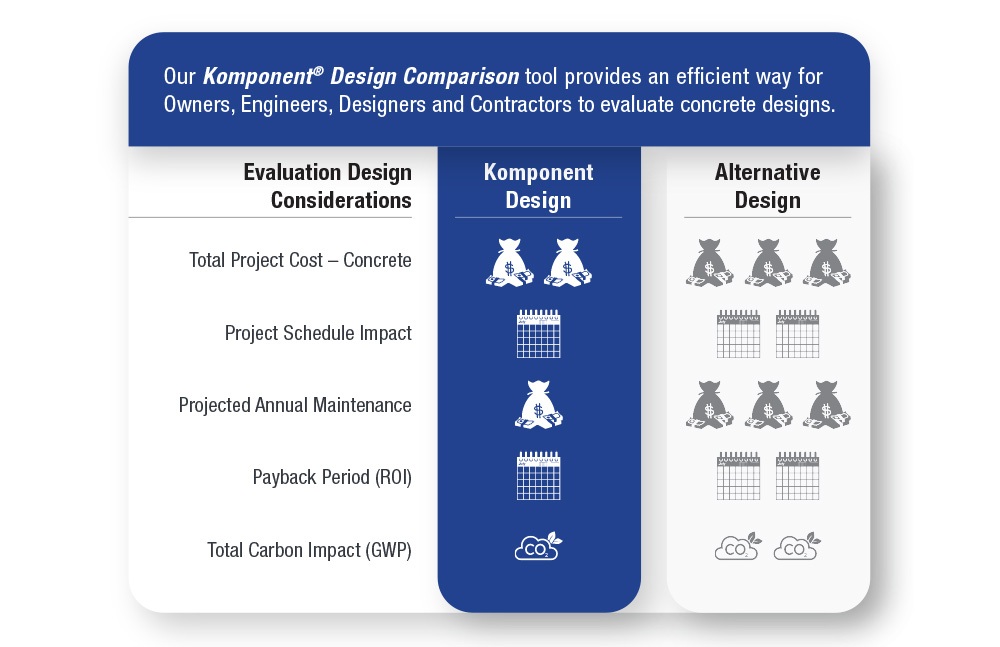
Contact us about the Komponent® Design Comparison Tool that provides an efficient side-by-side evaluation of:
For example, a data center comparison might evaluate:
Conventional option: traditional joint spacing, conventional reinforcement and shrinkage allowances, a thicker slab, more mobilizations, schedule impacts, a defined maintenance allowance for future joint, crack or other concrete maintenance, and overall carbon impact (GWP) of the design.
Komponent® option: extended joint spacing, reduced reinforcement requirements, tighter shrinkage allowances, thinner slab thickness, fewer mobilizations, schedule impacts, reduced maintenance allowance, and overall carbon impact (GWP) savings of the design.
The comparison tool allows the owner and engineer to evaluate established design requirements with performance expectations and verify proposed designs using applicable industry standards and design methodologies. This ensures a more objective, holistic approach when evaluating concrete designs and their ultimate sustainability impacts.
Specify performance to minimize risk
Where durability and in-service uptime are paramount, more robust performance specifications are needed. Specifications should address tighter shrinkage specifications for longer periods of time. Standard 28-day laboratory test results are not true indicators of in-situ long-term performance. To achieve improved dimensional stability and improved designs, shrinkage testing submittals should reflect 56- or 90-day behavior (or more extended timeframes when project timelines allow).
During construction, the focus is on short-term test data to move forward on critical path items to meet project schedules. During use, the operational efficiency and facility budget are dependent on longer-term performance outlooks. Evaluating optimized design options and verifying performance through longer-term testing should be considered early, during preliminary design and negotiations. For accelerated data center programs and other hyper-scale projects, later stage material substitutions should require verification of longer-term performance to prevent late-game impacts on durability, schedule, and sustainability impacts.
Future data centers demand more adaptable designs
Larger campuses, higher equipment densities, increased liquid cooling, more energy infrastructure, and growth in regions that may present different geotechnical, climatic, seismic, labor, and supply-chain conditions are all impacting data center designs.
Structural systems will need to support:
No concrete material solves all of these issues. However, Komponent® Type K ShCC designs address the most critical aspects of structural concrete design – durability and dimensional stability while helping improve project schedule and meet rigorous sustainability goals.
Conclusion: Design structural concrete for maximum operational performance
The rapid expansion of data center construction presents structural engineers with new challenges and new opportunities to innovate concrete slab designs. Next-generation FEA analysis tools allow them to do it more efficiently and accurately. And the current materials landscape with new blended cements in every market necessitates more extensive material evaluations to deliver on performance requirements.
Komponent® shrinkage-compensating concrete offers a proven, industry standards-basedapproach to improving dimensional stability, durability and performance while improving efficiencies during construction, and maximizing sustainable design.
For mission-critical facilities, it delivers engineered value that’s worth a conversation.
Contact a member of the Komponent® Engineering Team to find out more. Schedule a 15-minute Roundtable discussion, request full project review, prototype design optimization, design comparisons, specification review and more. We are here to help you meet the demanding schedule, sustainability, budget and performance requirements of hyperscale facilities.